
November 17, 2025
Updates to your digital toolbox: CropIPM
Learn how to use CropIPM.
If you are looking for pest management information, CropIPM and the Crop Protection Hub (Crop Hub) have you covered!
What is CropIPM?
CropIPM is OMAFA’s resource for crop-specific integrated pest management (IPM) information. Ahead of the 2024 growing season, OMAFA released a new and improved version of CropIPM. The new CropIPM site includes:
- Updated crop-specific IPM information
- A new identify feature to help you identify weeds, diseases, disorders and insects
- Scouting calendars
- Comparisons of often-confused-with pests
Since the release of the new CropIPM website, information on key pests that impact apple orchards has been continually updated.
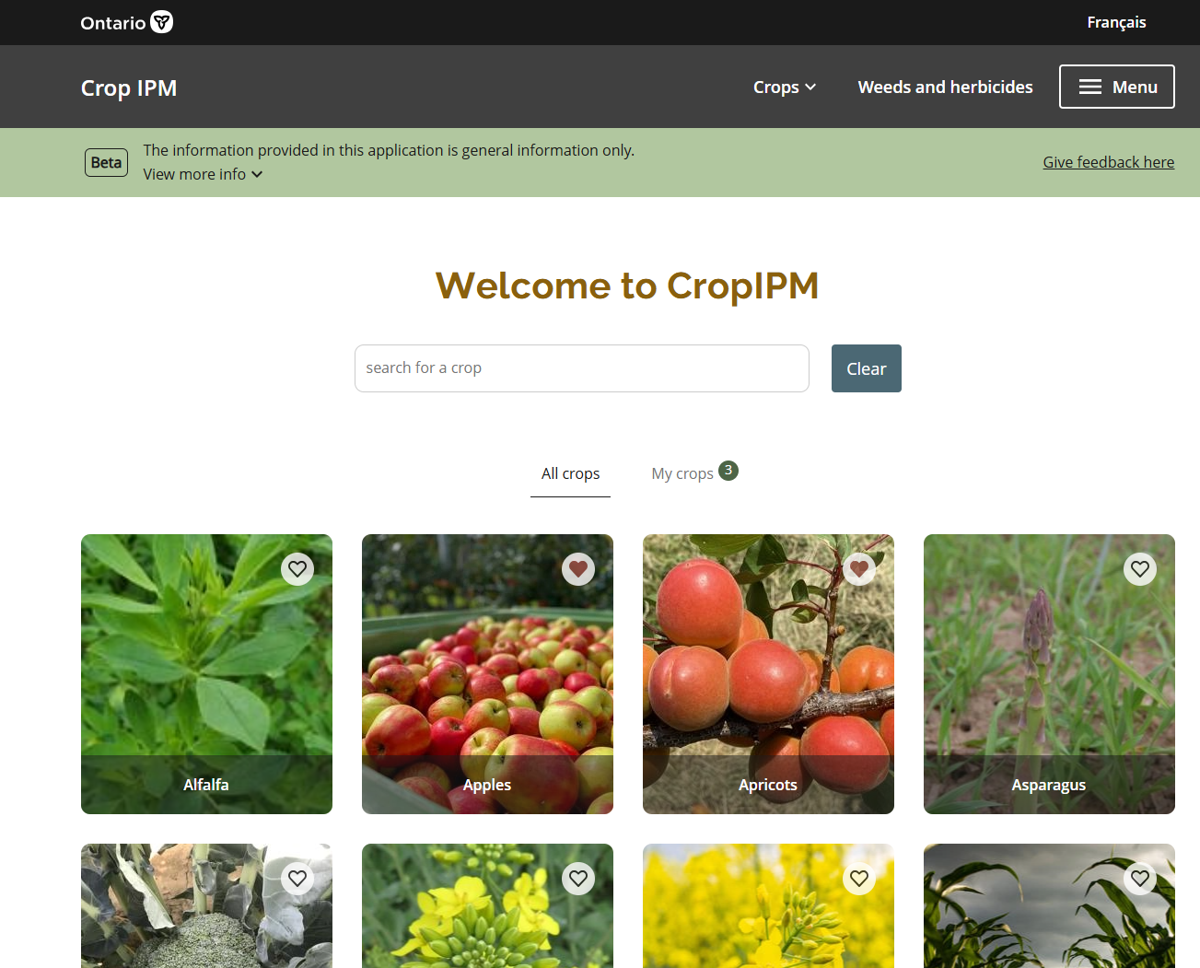
If you have not used CropIPM before, navigating to the apple module is easy! On the homepage, click on the apple image or use the search bar to type in your desired crop.
Tip: Growing multiple crops? Use the heart icon in the top right-hand corner of each crop image to favourite that crop module. While still on the homepage, click on the “My crops” button to see only the crop modules that you’ve favourited. Bookmark this page using your browser’s bookmark feature so you can skip searching for a crop on your next visit!
Key Features of CropIPM
Once you are in a crop module, you can access crop-specific information by navigating through each tab beneath the crop image banner. Below is an outline of some key features of Crop IPM and how you might use them.
Quickly view periods of pest activity with “Scouting”
In the orchard and wondering which pests you should keep an eye out for? The scouting calendar is a great tool! Considering the growth stage, you can quickly identify which diseases and insects are more likely to be observed during that time. To learn more or verify what you’re seeing in the orchard, you can click on the pest name from the scouting calendar. This will take you to the pest page where you can access identification information, images, management notes and more!
When viewing the scouting calendar on your desktop, you’ll see all growth stages across the top, with pests categorized by disease or insect along the left side. Each coloured bubble corresponds to the likelihood of seeing the pest at that stage. As you hover over the coloured bubble, text will appear with the corresponding observation rating. When using a mobile device, the view of growth stages will be narrowed to one stage at a time. To switch to a different growth stage, click on the growth stage text and select a new growth stage. To see the legend, click on the information icon in the bottom left corner or click on an individual coloured bubble to see how likely that pest is to be observed.

Explore and identify pests with “Identify”
The “identify” tab will show all images of pests included in the apples module. If you aren’t sure what pest you are seeing in your orchard, this is a great place to start to narrow down what you are looking at. You can begin filtering images using the “part of crop affected” filter and select options like “blooms” or “fruit” depending on when and where you are seeing the pest/pest damage. Additional filtering for insects, diseases or disorders can help you further narrow your results.
To help verify which pest you are seeing, click on a pest image. This will bring you to the pest page, which includes information on pest identification and biology, additional images of the pest and more, outlined in the next section.
Looking for pest-specific management information?
If you already know the pest you are seeing in your orchard, go to the insect, disease, problematic weeds or disorders tab and navigate to the identified pest.
Once in the insects and mites, diseases, disorders or problematic weeds tabs for the pest you’ve already identified, click on the pest image. This will bring you to the crop-specific pest page (which can also be accessed through the scouting calendar or identify tab). Here you can view key information on identification, biology, often-confused-with pests and management notes.
If you have feedback on these changes or thoughts on how we can further improve CropIPM, please email ag.info.omafa@ontario.ca or use our feedback form.